
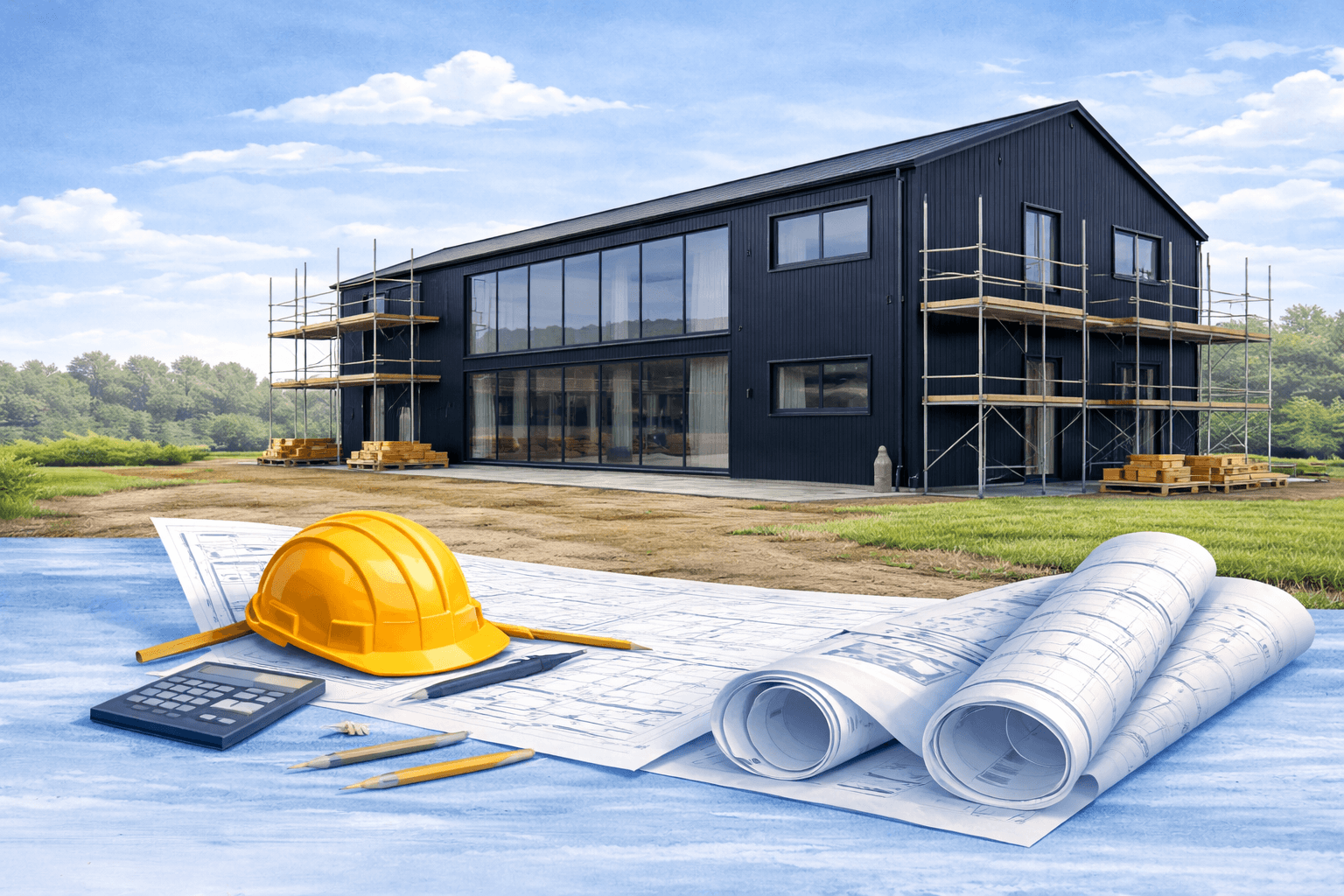
Every house build follows a sequence.
It doesn’t always look the same in detail, but the structure is consistent.
Planning. Design. Groundworks. Structure. Internal works. Completion.
Most people understand that at a high level.
The difficulty is not knowing the stages.
It’s understanding what each stage actually requires, and how they connect.
Why stages matter more than they first appear
Stages are not just a way of organising the build.
They define when decisions need to be made.
They determine when money is required.
And they shape how the project moves from one point to the next.
If that structure isn’t clear, it becomes harder to stay in control.
Things start to overlap.
Decisions are made later than they should be.
Costs begin to shift without being fully understood.
A typical sequence of stages
While every project is different, most follow a similar path.
Early stage: defining the project
This includes initial ideas, feasibility, and planning.
At this point, most costs are still assumptions.
The focus is on what the project could be.
Design and pre-construction
Drawings are developed, details are refined, and the project becomes more defined.
Costs start to become clearer, but they are still not fixed.
This is often where expectations begin to meet reality.
Groundworks and structure
The project moves from design into construction.
Foundations, structure, and external envelope are completed.
Costs at this stage are more certain, but risk still exists, particularly around ground conditions and structural complexity.
Internal works
The project becomes more detailed.
Mechanical, electrical, and finishing elements are introduced.
This is where a large number of decisions are made.
Many of them affect cost, but not always in a way that is immediately visible.
Completion and finalisation
Final works are completed, and the project moves towards handover.
At this stage, most costs are known, but changes can still occur.
Often in the form of finishing choices or late adjustments.
Where projects tend to lose alignment
The stages themselves are not the issue.
The problem is how they are managed.
If each stage is treated in isolation, it becomes harder to see how the project is moving overall.
Decisions made in one stage can affect what happens later.
Costs can shift between stages without being tracked clearly.
Timing changes can impact when money is needed.
Without a joined-up view, it becomes difficult to understand the full position.
Why visibility across stages matters
A project is not just a series of tasks.
It is a sequence of decisions, costs, and timing that all connect.
Understanding that connection is what keeps things aligned.
It allows you to see:
What has already happened
What is currently in progress
What is coming next
And how each stage affects the overall position
Without that, the project can feel like it’s moving forward, but not always in a controlled way.
A more structured way to approach it
Most people don’t struggle because they don’t know the stages.
They struggle because they don’t have a clear view of how those stages interact as the project progresses.
Keeping that structure visible changes how the project behaves.
It brings clarity to both the build and the financial position at the same time.
That’s exactly what BuildaPath is designed to do.
Not by changing the stages, but by making them easier to understand, manage, and connect as the project moves forward.
Related reading: